;
Showing posts with label bristlenose. Show all posts

Tuesday, 21 June 2016

Ancistrus claro, Lda008 part 1: selecting fish


I dare to say that all hobby aquarists have one dream fish that they would like to keep, the one that never seems to become available, perhaps the one that got away even. For me the dream fish has for a long time been the little riverine loricariid: Ancistrus claro, Lda008.

This however changed in January 2016 as Stork Zoo in Gothenburg were able to import a wild caught group through Austria. I bought nine individuals in total, in retrospect I regret not buying more but there is no reason to cry over spilled milk (fish?).

These fishes are recognized by their small size, flat and wide body shape resembling that of Chaetostoma as well as their beautiful reticulated patterns, especially in certain males.  

I opted to try and pick out five females and four males, simply as it’s easier to spot young males then females. If it turns out that some of the “females” in reality are males that’s fine too as there should at least be a couple of girls in there.

The males were picked out due to traits such as a “fat lip", more bristles and a stronger reticulated pattern.
These are the four possible males selected:


The females were a bit trickier to pick out. They were chosen due to traits such as the lack of a “fat lip", minimum amount of bristles and duller more spotted patterns. Looking at the photo now afterwards it looks like there could be a small male in there too, time will tell.
These are the five possible females selected:


The fishes now reside in the 375 litre community tank pictured below. I had nothing prepared for them at the time so it had to do as a temporary accommondation. The community tank does however suit the species quite well in that it is furnished with lots of pebbles, rocks and roots and has a moderately strong current.


That’s it for my intial impressions of the Ancistrus claro and selection of individuals. The next post in this series should include setting up species tanks for these little fishes as well as a follow up on sexing.


Tuesday, 24 September 2013

R.I.P, death of a red & black Ancistrus male, rivalty with L134 leads to death


I'm saddened to write this but I do not want to write about only the positive sides and successes of fishkeeping.

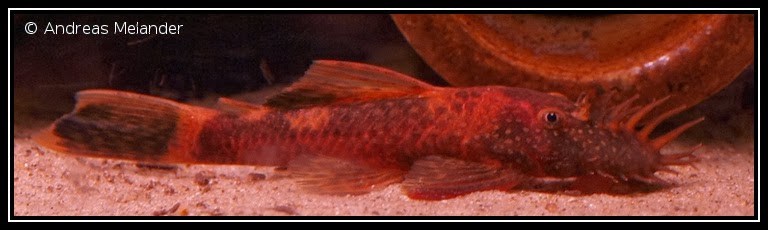
My alpha male, calico red & black Bristlenose pleco was killed yesterday. The photo was taken when the fish was young but in it's adult form it was a very impressive fish.

This fish was approximately 4 years old, in it's prime and should have had many more years, it has supplied me with a constant stream of quality fry.

I foolishly decided to house the fish temporarily with my Peckoltia  compta / L134 group to give it a break from breeding. I knew there could be trouble between the males but did not expect it to lead to it's death. There were more than six empty caves in the tank but this was not enough. The carcass bore clear signs of fighting with another pleco, my suspicion points to the L134 alpha male.

This is something that could easily have been avoided and a decision I will regret. So a warning to anyone wanting to move several boisterous male loricariids into the same tank, monitor them carefully and obviously provide plenty of space and caves!

Wednesday, 19 December 2012

Ancistrus sp., sexing revisited

Ancistrus sp., females with bristles

It now turns out that I was right about the young female, one of the males however turned out to be a female which im very happy about.

In the end it seems that both males and females grow bristles quite early, it is however still possible to somewhat accurately sex the juveniles by the amount of bristle growth.

Juvenile male, one year ago:


Juvenile female, one year ago:


The male, today:


The females today:


They still need to put on some weight but I am hopeful about getting some fry from these next year.

Melander

Saturday, 16 June 2012

Very small/young Bristlenose father


The picture above shows a common Ancistrus male, he is about 5-6 cm in total length and between 5-6 months old. The cave is approx 4 cm wide.

This male is guarding it's first batch of eggs and the mother was an large adult female.

The male seems to have developed really early and already have a full set of bristles with split end.
There were no adult males in the tank as I did not intend to breed the female, this could have lead to that this little lad got his chance.

Even though this male developed very fast it is proof of just how productive this species is when it comes to breeding.

From now on I will have to separate the young males from the girls much earlier than i have been doing so far.

Melander


Sunday, 25 March 2012

Beautiful day at the beach, driftwood and 160 litre aquarium


I have a few minor updates today. It was a beautiful and sunny day in County Wicklow and I took to the beach twice. Got this nice piece of driftwood with me home:


The 160 litre tank is finally repaired too, to my distress my first attempt failed. As I had removed the silicone around the leak I resealed the tank, however it seems that the old silicone was no good and the tank sprung a leak in a different location as soon as I filled it. I decided to remove all of the silicone and redo the whole job, this worked and I’m so relieved that it did.

The tank is now run by an Eheim Ecco pro 200 external filter, an Eheim 2x 100L/h airpump(one sponge filter), it has one 200w and one 100w heater.

The setup is far from complete but I’m glad it’s up and running. At the moment there is one large piece of driftwood and one Java fern along with guppies and bristlenoses in it but I’m planning for other inhabitants soon. This is how it looks now:


Previously I used a wooden cover for the tank, it looked good but was not really practical and I decided to line the top of the tank with wood and sawed out a lid out of Perspex:


The 144 litre is pretty much the same; I have however started to treat this piece of driftwood which will replace some of the wood in the tank:
 

That’s it at the moment, cheers for watching!

Melander

Wednesday, 22 February 2012

144 litre tank


 I have finally moved my old 144 litre tank, here's a pic:


I decided to get rid of all the stones for now and I think the wood looks better but it’s much harder to hide the caves. I have a few smaller pieces of wood to go in and some smaller stones so hopefully that will do it. The bright orange caves that stands out really annoys me at the moment.

The plants are a bit of a mess as this moving business has taken its toll but I'm sure they will recover.

The fish seems ok but a bit frightened; I'm going from a acidic pH to a neutral, that's why the tank is not fully filled yet. Hopefully they will acclimatize ok. I used most of the water that was in the tank originally and I'm adding small amounts of the new neutral water two times per day.

At the moment there are two Peckoltia compta, three bristlenoses, 25+ Corydoras panda and 4 Corydoras Schultzei in the tank. The C. Schultzei will be moved a.s.a.p to prevent hybridisation.

Plants include: one Anubias heterophylla and three small Echinodorus bleheri.

Still loads more to do as I have to set up the new tank too.

Melander

Friday, 27 January 2012

Ancistrus sp., sexing


These fish were sold as Ancistrus sp. L180

They have now started to "bristle up" and three are obvious males, like this lad:


I'm however hopefull that this one is a girl:


I have already had comments on this but would like to hear from more people so please feel free to comment below!

Cheers, Melander